
Hi nerds! There’s a good chance you used distillation today without realising it. Maybe it was in the perfume you sprayed, the essential oils in your diffuser, or, more importantly for us, the whisky in your Old Fashioned. Distillation is one of humanity’s oldest crafts. What started as a way to make perfumes and medicines eventually gave us the spirits that define whole cultures, shape drinking rituals, and line every backbar on the planet.
So let’s take a long walk through history. From Aristotle’s seawater experiments to the birth of brandy, whisky, and gin. From Arab alchemists in the desert to Grey Goose in a frosted bottle. Because if you’re going to sling drinks for a living, you might as well know the stories behind them.
What is Distillation?
Distillation is simple in theory: heat a liquid, capture its vapors, cool them down, and collect the condensed liquid. Different substances boil at different temperatures, so you can separate alcohol from water, or aromatic oils from a plant mash.
In short:
Heat → Evaporation → Cooling → Condensation → Collection
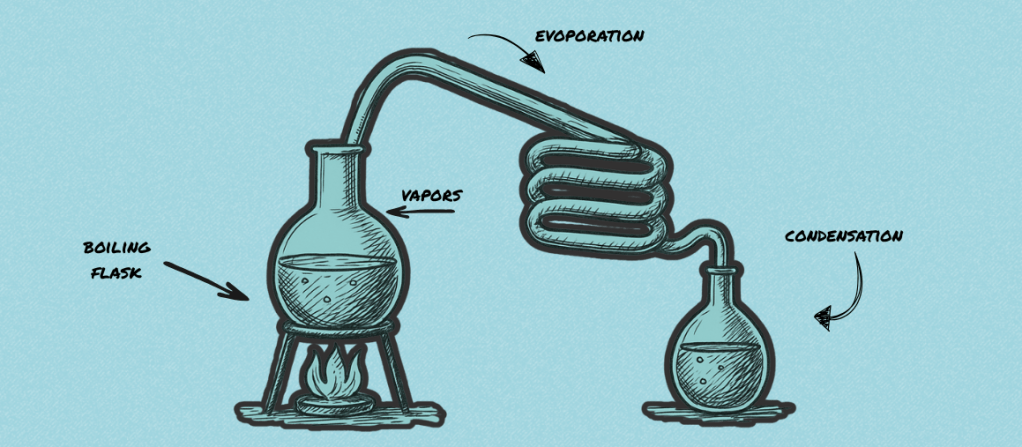
That’s the skeleton. Everything from whisky to baijiu is just a different skin on the same bones.
The Ancient World: Perfumes, Medicine, and Curiosity
The first distillers weren’t chasing cocktails – they were chasing cures and scents.
- 4th century BCE, Greece – Aristotle observes that seawater becomes drinkable after evaporation and condensation. Not alcohol yet, but the principle is there.
- Egypt, Mesopotamia, China – Distillation is used to create perfumes, balms, and medicinal tinctures. Early stills were clunky, but they got the job done.
- 8th–9th century, Arab World – Scholars like Jabir ibn Hayyan (Geber) refine the alembic still. Copper pots, long necks, condensing tubes – all familiar if you’ve ever toured a modern distillery. At this stage, they’re extracting essential oils and plant essences, not booze.
Then comes the big leap.
The Middle Ages: From Medicine to Magic
- 11th century, Persia – Avicenna invents the spiral cooling coil, making condensation more efficient. This upgrade changes everything.
- 12th century, Salerno, Italy – The famous Salerno School of Medicine mixes Jewish, Greek, and Arabic knowledge. They adapt the alembic to create alcohol – consumed only as medicine, called aqua vitae (“water of life”).
- 14th–15th century Europe – Alchemists are obsessed. They’re not after happy hours – they’re after immortality, gold, and divine secrets. In the process, they discover that redistilling alcohol makes it stronger and purer. Enter Basil Valentine, who in 15th-century Germany suggests cooling tubes in water baths and double distillation. Still used today.
What started as medicine is about to become pleasure.

1300–1499: The First True Spirits
- 1310, France – Vital du Four writes about Armagnac, calling it both a cure and a source of joy. The first official nod to a grape spirit.
- 1405, Ireland – Earliest written reference to uisce beatha, the ancestor of whiskey.
- 1494, Scotland – A friar named John Cor gets malt to make whisky. The first official record of Scotch.
By the end of the 15th century, Europe had its first true spirits. And people weren’t just “taking them as medicine” anymore.
1500–1699: Styles Are Born
- Netherlands – Jenever, the ancestor of gin, appears in Antwerp. A medicinal grain spirit flavoured with juniper berries.
- 1575, Amsterdam – Lucas Bols sets up shop. If you’ve ever poured Bols liqueurs, you’re part of that history.
- France & Spain – Brandy styles take shape. Italy develops grappa. Scandinavia drinks aquavit.
- 1600s, Japan – Shochu emerges in Kyushu. Sake brewing is already centuries old.
- 1689, England – William of Orange encourages gin production. The English gin boom begins.
- Late 1600s, Caribbean – Rum production explodes. By 1703, Mount Gay is distilling in Barbados, and the sugar-to-spirit pipeline is fueling empires.
Distillation is no longer just a science experiment. It’s culture, identity, and trade.

1700–1919: Golden Age and Colonial Expansion
This is the age when spirits stop being local oddities and start becoming global players.
- Russia – Vodka becomes a national symbol.
- Europe – Hennessy (1765), Gordon’s Gin (1769), Pernod absinthe, and Martini & Rossi vermouth (1863).
- Italy – Vermouth and bitters explode: Carpano (1786), Campari (1860).
- Mexico – Jose Cuervo (1795), Herradura (1870), Sauza (1873). Tequila steps into history.
- Caribbean & Americas – Appleton (1749), Bacardí (1862), Jack Daniel’s (1866).
- Asia – Baijiu (Moutai) is formalized in 1899; Japan and Korea scale up sake and soju.
Spirits are now not only drinks – they’re brands, empires, and commodities of global trade.
1920–Today: Branding, Premiumisation, and Revival
- 1920s, USA – Prohibition. Speakeasies thrive, cocktails evolve.
- 1923, Japan – Suntory’s Yamazaki distillery opens.
- 1950s–70s – Branding takes over. Maker’s Mark, Baileys, Absolut. Havana Club gets reborn.
- 1980s–90s – The premium wave: Bombay Sapphire, Grey Goose. Spirits are marketed as luxury lifestyle.
- 2000s–Now – Craft distilleries boom. Japanese whisky wins global awards. Mezcal and tequila go premium. Baijiu quietly becomes the world’s best-selling spirit by volume.

Why It Matters Behind the Bar
When you pour a drink, you’re not just pouring liquid. You’re pouring history.
A Daiquiri is colonial trade routes in a coupe.
A Highball is Japanese precision in a tall glass.
A Gin & Tonic is empire in a fizz.
Knowing distillation’s journey – from Aristotle to alchemists, from Armagnac to modern luxury brands – gives you stories to tell and context to share. It makes your cocktails more than just recipes; they become a conversation with history.
So next time someone asks what’s in their glass, don’t just say “rum” or “brandy.” Give them the journey.
If you find our project valuable and useful – support us with a subscription.
Quick Glossary
Alembic / pot still – traditional batch still, rich and flavourful distillates.
Column still (Coffey still) – is a continuous distillation system that produces cleaner, higher-proof spirits than pot stills, powering everything from vodka to light rum.
Heads / Hearts / Tails – the bad, the good, and the ugly cuts of a distillate.
Double distillation – the classic trick for stronger, purer booze.
Stay boozy, stay nerds

Leave a comment