
Every shift, bartenders use a huge variety of tools – often without even thinking about how they work. Our hands just do the moves automatically. But what we now consider the bare minimum of bar gear has actually been developed and refined over decades.
Today, we’re going back to the roots of some of our everyday tools. In Part 1, we’ll talk about the shaker and the jigger. In Part 2, we’ll move on to the strainer and the bar spoon. Let’s roll.
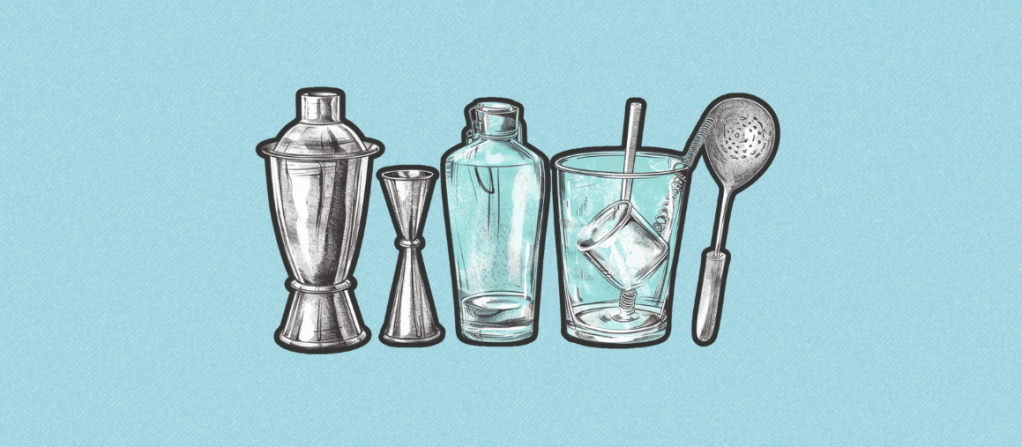
The Shaker
The history of the shaker is both straightforward and a little messy.
The earliest shaker-like vessels date back to around 7000 BC – gourds with traces of alcohol inside. Whether they were actually used for mixing or just for storage is still up for debate among archaeologists.
Fast forward to the mid-19th century – the period when the modern cocktail shaker was born.
The idea of pouring liquid from one vessel to another wasn’t new. Cooks had been doing it for ages to quickly cool hot milk and other liquids. So when cocktails appeared, bartenders naturally picked up a similar technique – the now-famous throwing, where you pour the drink back and forth between two tins. The Blue Blazer is a perfect example.
The first mention of a modern shaker appears in 1848 in the New York Times:
With his shirt sleeves rolled up and eyes on fire, the bartender seems to be pulling a julep in a long ribbon from a tin cup.
Shakers really took off after the 1850s, when cocktail culture exploded. At the time, the standard was the Boston shaker – a tin paired with a glass, much like what many American bartenders still use today.
By the late 1890s, shakers were going through a design boom. Patents appeared for penguin-shaped shakers, top hats, club symbols – you name it.
By the early 20th century, two main types dominated: the Boston shaker in the US and the more elegant Parisian shaker in the UK, which looked a bit like an urn.
And then came 1884, when Edward Hauck patented the three-piece shaker – tin, built-in strainer, and cap. This was the Cobbler shaker, named after the hugely popular Sherry Cobbler. It became a hit with home bartenders, removing the need for a separate strainer.

The Jigger
The hourglass-shaped jigger we know today was patented in 1893 in Chicago. But measuring cups for booze had existed long before.
The shape was simply practical – maybe even inspired by an egg cup. But the name? That’s a more complicated story. There are three main theories (plus one from cocktail historian David Wondrich):
- Nautical roots – British sailors used jiggermasts (the smallest mast) as a nickname for their tiny daily rum ration cups.
- Canal workers’ slang – In 19th-century New York, Irish labourers digging canals were served whiskey by a “jiggar boss” (basically “the guy with the booze”). Over time, “jiggar” became “jigger.”
- Simple barware term – In 1879, the New York Herald describes a “jigger” as a small conical metal vessel for mixing unusual drinks.
And Wondrich’s own take:
In English, the word jigger, like thingamajig, just means an object without a better name.
That’s it for today, folks. Don’t cheap out on good equipment – the right tools make the job a joy.
Thank you for reading, and if you find our project useful – support us with subscription
Stay boozy, stay nerds

Leave a comment