
The Strainer
The history of this bar tool goes back to the early 19th century – the moment ice started showing up in drinks. That’s when ice traders began shipping frozen blocks from the North down to hot cities like New Orleans, where people were more than happy to enjoy mixed drinks. Naturally, they needed a way to keep the ice out of the drink when serving it.
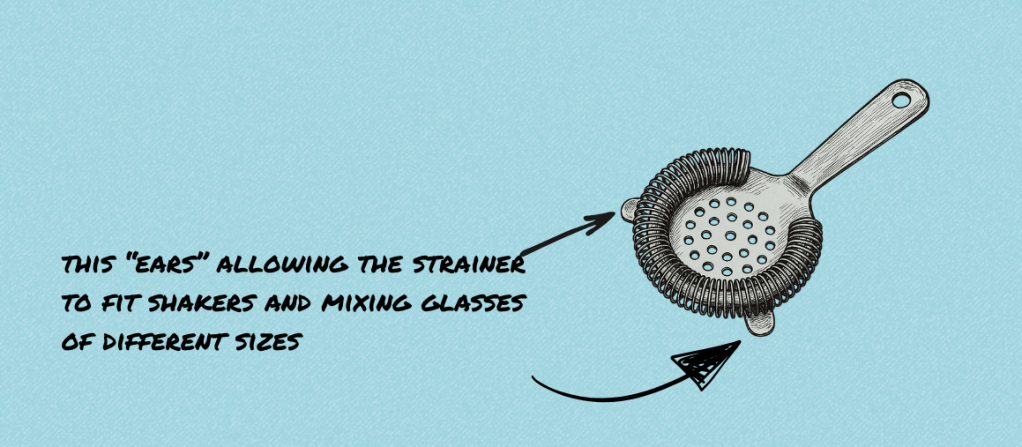
Julep Strainer
In the beginning, the first “proto-strainers” were simply perforated spoons – the kind used to skim fat off soup or scoop out a poached egg. As mixed drinks grew in popularity, the design and materials evolved into what we now know as the classic julep strainer.
But why was it needed at all? After all, straws were already in mass production – cheap and easy to use. In 1839, the New Orleans Picayune reported that “true julep connoisseurs carry their own silver straw,” which makes you question whether julep strainers were even necessary.
One theory says it was all about dental hygiene – people with inflamed gums or sensitive teeth didn’t want ice hitting their enamel. But that still doesn’t solve the problem of icy liquid touching the teeth.
The most convincing explanation? The “Golden Age of Beards” in the late 19th century, when a fine moustache was a must-have for any gentleman. Add to that the popularity of juleps, cobblers, and smashes, and you can imagine the mess. Ice, fruit garnishes, and moustaches don’t mix well. In 1878, Leo Engel wrote: “Smashes should be drunk through a julep strainer, or with a ‘moustache mug’ (a special cup that kept your moustache dry).”
Although the julep strainer became a status symbol alongside silver trays and fine crystal, it was eventually replaced in most bars by the Hawthorne Strainer.
Hawthorne Strainer
Bartenders and inventors were constantly trying to improve the julep strainer. One such patent kept the name “julep strainer” but completely changed the design. Today, we know it as the Hawthorne Strainer – named after a Boston café, The Hawthorne, which used it.
The innovation was simple but brilliant: a coiled spring and stabilising “ears,” allowing the strainer to fit shakers and mixing glasses of different sizes. That made it truly universal.
Most modern bartenders use a Hawthorne without the ears – simpler, quicker, more ergonomic. Still, julep strainers and classic Hawthornes can be found behind the bar, either as backup tools or for serving special drinks to special guests.
The Bar Spoon
It makes sense that the bar spoon evolved from the regular spoon. The earliest spoon-like tools go all the way back to the Paleolithic era, when humans used shells, bits of wood – basically anything that could hold food.
One possible ancestor of the bar spoon comes from medieval medicine, where similar tools were (rather grimly) used for obstetric purposes. But let’s look at the more pleasant history.
Sucket Spoon
The first documented “long-handled spoon” dates to 1279 in Germany – the sucket spoon. It was designed for a popular British dessert called “sucket” (fruits preserved in syrup). The forked end was for spearing the fruit, while the spoon was for the syrup. Queen Elizabeth I was one of its biggest fans.
By the late 19th century, American bartenders had adopted it – particularly for serving cobblers. Guests could stir their drink and scoop out the fruit at the same time.
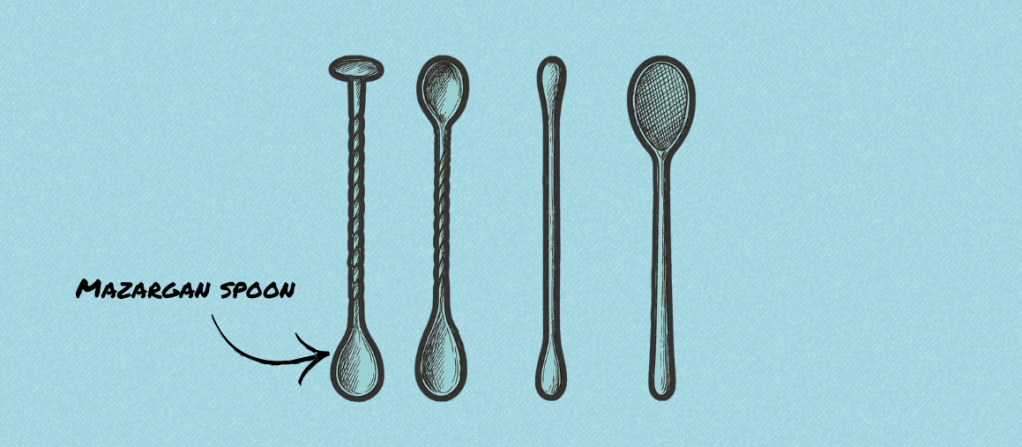
Mazargan Spoon
The spoon with a muddler on the other end came from apothecaries. In 18th-century France, the cuillère medicament was used to grind medicines into powder, with the spoon measuring the correct dose.
By 1898, this design appeared in the Farrow & Jackson catalogue as the “French Mazargan Spoon,” alongside a twisted-handle “bar spoon.” It reappeared in Charlie Paul’s 1902 cocktail book and in Louis Fouquet’s Bariana.
The name Mazargan comes from an 1840 battle near the Algerian town of the same name. A coffee-based drink drunk by soldiers there became trendy in France: espresso in a tall glass with beet sugar, crushed with the muddler end, topped with cold water.
Today, the Mazargan spoon is the most common bar spoon worldwide – though the name itself faded away a century ago. It’s perfect for layering drinks like a Pousse Café or floating wine on a New York Sour.
Over three centuries, bar spoon tips have changed – some decorative, some flat, some teardrop-shaped for better stirring. But the core idea remains the same: a long, elegant tool that’s part utility, part style.
Thank you for reading. And if find our project useful – support us with subscription
Stay boozy, stay nerds


Leave a comment